"Large, and Without Mercy"
Ten Years of Writing about Photography: Western Highways

April 2026 marked the 10th year that I have been writing about photography. I don’t write about film and lenses and cameras (don’t ask me what camera you should buy for your nephew); rather, I write about what photography teaches us about our world and about ourselves. In early 2016, I sent Tim Anderson, Editor and Publisher of Shadow & Light Magazine, some of my work, and he published it. Tim’s magazine became the primary home for my writing. Both an editorial relationship and a friendship were born.
I celebrated those 10 years in the most recent issue of Shadow & Light Magazine (May/June 2026) by revisiting 5 of my favorite essays, posting one photograph and some text from each. I want to recreate that here. For the next few weeks, I’ll post a photo and some text to give you a taste of what I’ve been up to over the past 10 years. If you’re intrigued by what you see and would like to read the whole essay, send me a message, and I’ll send you a PDF copy. And I would certainly encourage you to subscribe to Shadow & Light Magazine. Tim puts together an wonderful journal.
“Ode to Western Highways” resulted from a trip Julia and I made to the Southwest in 2016, two years before we moved here. We flew to Albuquerque and drove through western New Mexico and eastern Arizona to Monument Valley. Along the way, the enormity of this land was inescapable, while the water tank by the road (touched on later in the essay) spoke to the human present. “Ode to Western Highways” appeared in the September/October 2017 issue of Shadow & Light Magazine.
Ode to Western Highways
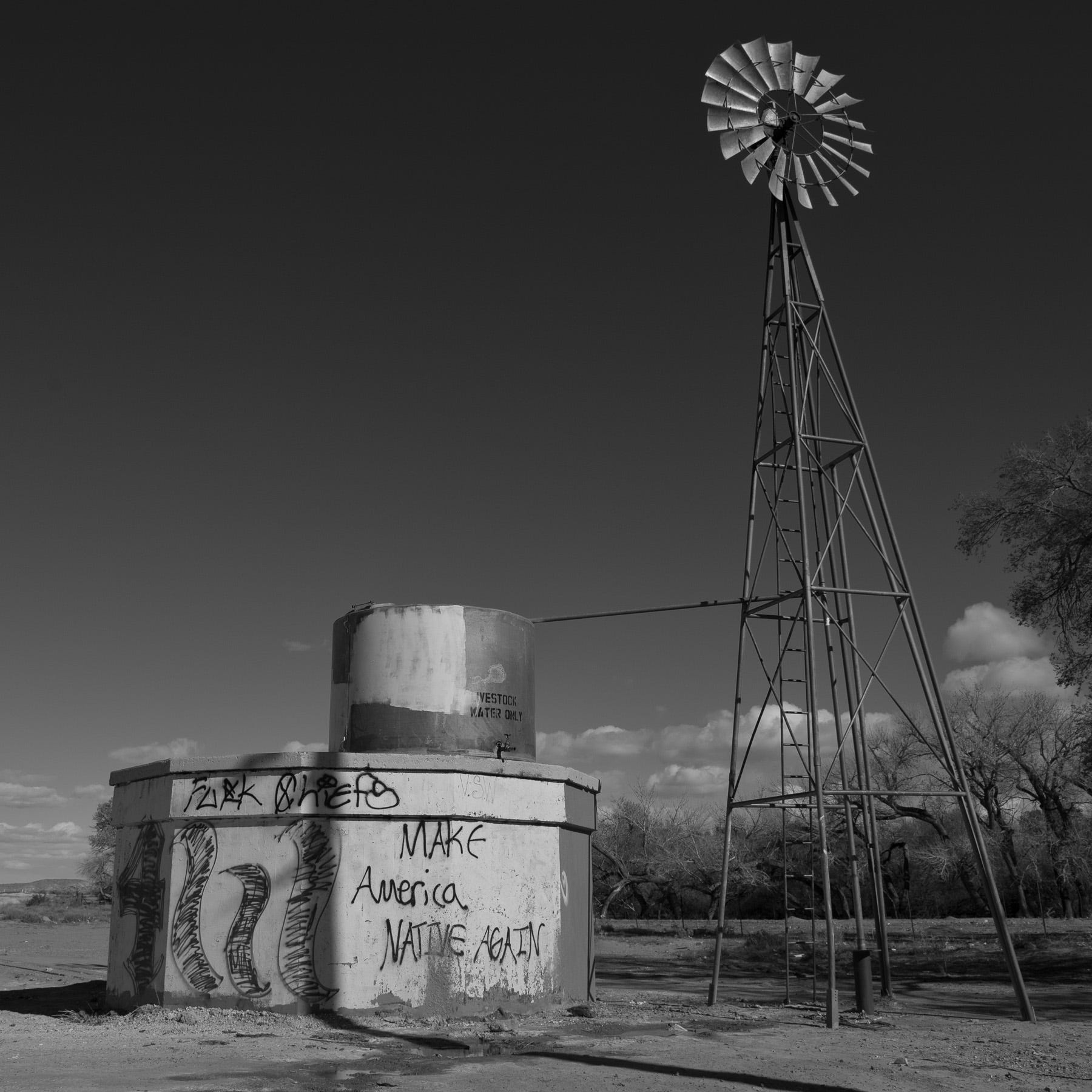
“I take SPACE to be the central fact to man born in America, from Folsom cave to now. I spell it large because it comes large here. Large, and without mercy.”
I had read the poet Charles Olson’s words - the opening lines of “Call Me Ishmael,” Olson’s meditation on Melville and the American character - years ago and they had seemed true to me then. But driving northwest across the Navajo reservation that afternoon, I truly felt Olson’s SPACE, and its profound indifference. There is so much space here in the American West, land and sky large almost beyond imagining. The narrow lines of crisscrossing asphalt highways attempt to make it all seem safe and familiar and manageable. It doesn’t work. And as Americans, I don’t think we want land that is manageable. We want land that holds promise, making us feel heroic in its face. But with that promise comes evidence of our fragility against an unending horizon.
Olson, again. “Some men ride on such space, others have to fasten themselves like a tent stake to survive.”
It’s tempting to think of Western highways as a location - the long straight roads in Kansas, for instance, where I used to bicycle on still summer mornings, trying to get my miles in before the heat built, almost drunk with the physical joy of moving across the prairie in a tall gear. But Western highways aren’t tied to geography. They take us back into the past as much as they take us from place to place. It’s why we try to retrace the old routes and restore the original gas stations, hiding digital displays in antique pumps. Western highways also partake of America’s restlessness. We find solace in being on the go. Pack the car, head for the highway, and suddenly we are lifted out of daily life, into a bardo-like state. A little bit of death accompanies setting forth and a little bit of rebirth greets us when we arrive. In between, something - caught off-guard I might call it my soul - opens.

If you’d like a copy of the entire essay, message me and I’ll send you a free PDF copy.
Thanks so much for the reflections and post. I look forward to seeing more of work decade long efforts