Wherever You Go . . .
Dreary skies in St. Louis

Even if I hadn’t known the itinerary and watched the landing from the window seat, I would have known we were in St. Louis the minute the plane door opened and the kerosene odor of jet fuel cleared. The low sky and steady rain looked like the weather I had grown up with in Iowa, while the humidity held the damp odors close. No question that I was back in the Midwest.
It’s been over 30 years since I left the Midwest, and the strong sunlight and pinon-juniper mesa country of northern New Mexico now feel like home to me. Driving through small suburban towns around St Louis on the way to the family event Julia and I were there to attend, I couldn’t help but look at the houses - close together, pitched-roofed, painted wood siding or aluminum, and almost each one with a front porch. We drove through the quiet streets as the sunlight faded and the lights in the houses cast yellow light into the gathering dark. It was the Midwest in winter as I remember it: dark, heavy, with little sky and the horizon an article of faith. So different from the adobe and stucco, flat-roofed buildings and immense Western sky of Santa Fe.
Wherever you go, there you are.
— Jon Kabat-Zinn
I had put my camera into my carry-on bag, thinking I’d take some photos at my niece’s birthday party and also wanting to play with a new manual-focus lens. I knew getting used to it would help me slow down and really look at what was in the viewfinder. Julia and I made our way to our hotel, relaxed for a bit, and then went out for dinner with her cousins. It was a family trip all around. The next morning, I left her asleep and headed out in search of a latte and a few photographs. The rain had stopped, but the wind from the northeast was cold, and the clouds, as they had been the day before, were dark and low.
Kabat-Zinn’s pithy quote is a challenge to the so-called “geographical solution,” the belief that changing location will solve personal dilemmas. That may be true in the personal sphere (I have doubts about that, but that’s fodder for another day). However, I took it another way as I was driving around searching for a coffeeshop and some photos to make. Traveling means being in the place you arrive in. I remember listening once to an elderly American couple in the airport in Oslo, complaining that none of the airport cafes had some American dish they wanted.
Kabat-Zinn reminded me to stick with the dreary Midwestern day I had been given, and see what photographs might be there.
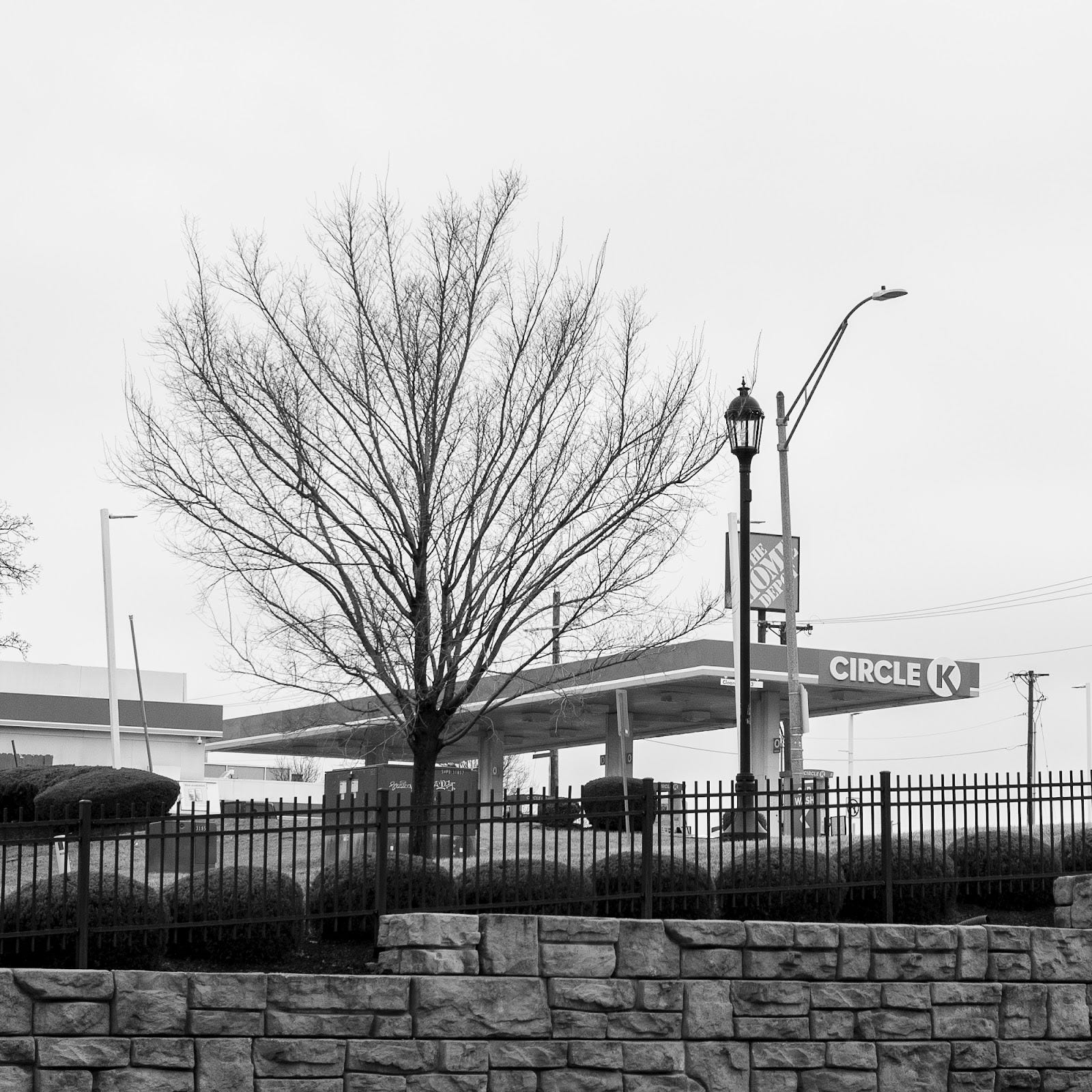
It was a Sunday morning, so the traffic was sparse, and I could easily pull over if there was something I wanted to look at more closely. The first thing that struck me was how many flat, straight lines there were in the buildings and landscape around me. Used to the warm, flesh-like contours of adobe and stucco that rarely hold a level or plumb line, my eye was drawn to what must seem commonplace to those who live nearby. The Circle K store, for instance, had so many layers of level lines along with the nearly fractal leafless tree. I had to look a little differently at this landscape than what I saw back home.
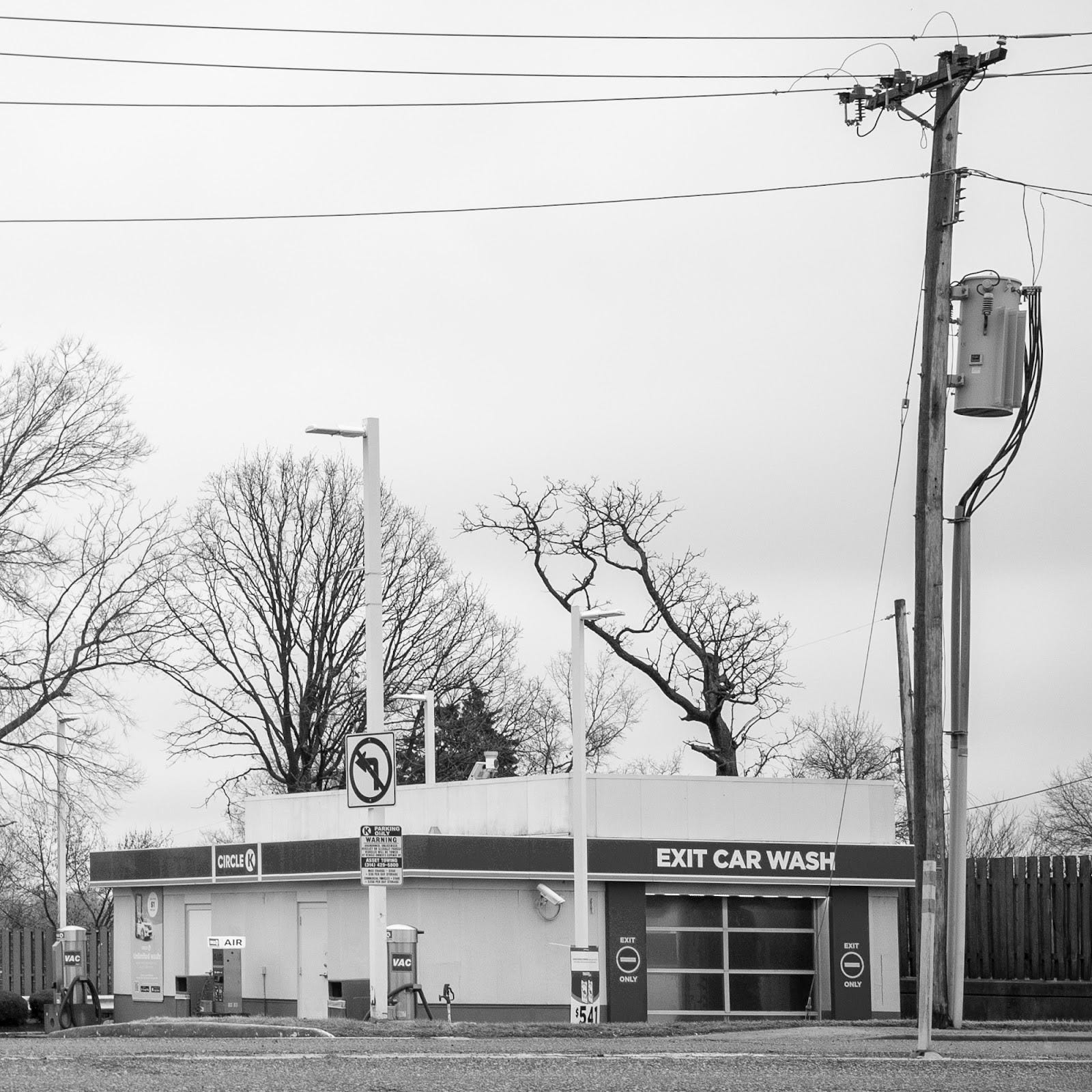
The Circle K offered several photographic opportunities. Here’s another. Again, the sharp edges and flat lines of the building contrast with the “messiness” of the bare trees in the background and the utility pole that blends a little of the two.
When you leave home, and if you go far enough, you also leave your language behind. Of course, they speak a version of English in the Midwest (“You betcha . . . . Welp, must be time to skedaddle . . . That cold builds character, yessir.”) that is largely understood by outsiders. But here I’m talking about photographic language, or more generally, an aesthetic language.
For a long time, I didn’t know what to make of photographs like my two of the Circle K (above) and the Wellness Clinic (below). There is a school of photographs like them, known as the New Topographics movement of the ‘70s. The photographers of the New Topographics movement turned their cameras from “pristine wilderness” to what they called the “man-altered environment.” Robert Adams photographed tract housing in Colorado. Lewis Baltz wandered through industrial parks to make his photos. Their photographs seemed like simple snapshots, representing nothing interesting, and I couldn’t understand why they were fine art. Their creators called them landscapes, but they didn’t fit what I knew a landscape to be. In place of the wide, romantic Western vistas of Ansel Adams and the f64 Group, I found photographs of suburban developments, strip malls, gas stations, and abandoned industrial sites lacking. It seemed incomprehensible. Who wanted to look at that stuff?
At some point, though, I realized that the New Topographics aesthetic was like a manifestation of another language, a language that made room for the mundane scenes of urban life, unromantic, formal. Something drew me back to Adams and Baltz and others, even when I found their work difficult to understand. The photos weren’t classically beautiful, but they felt true. Gradually, what these photographers intended emerged for me.
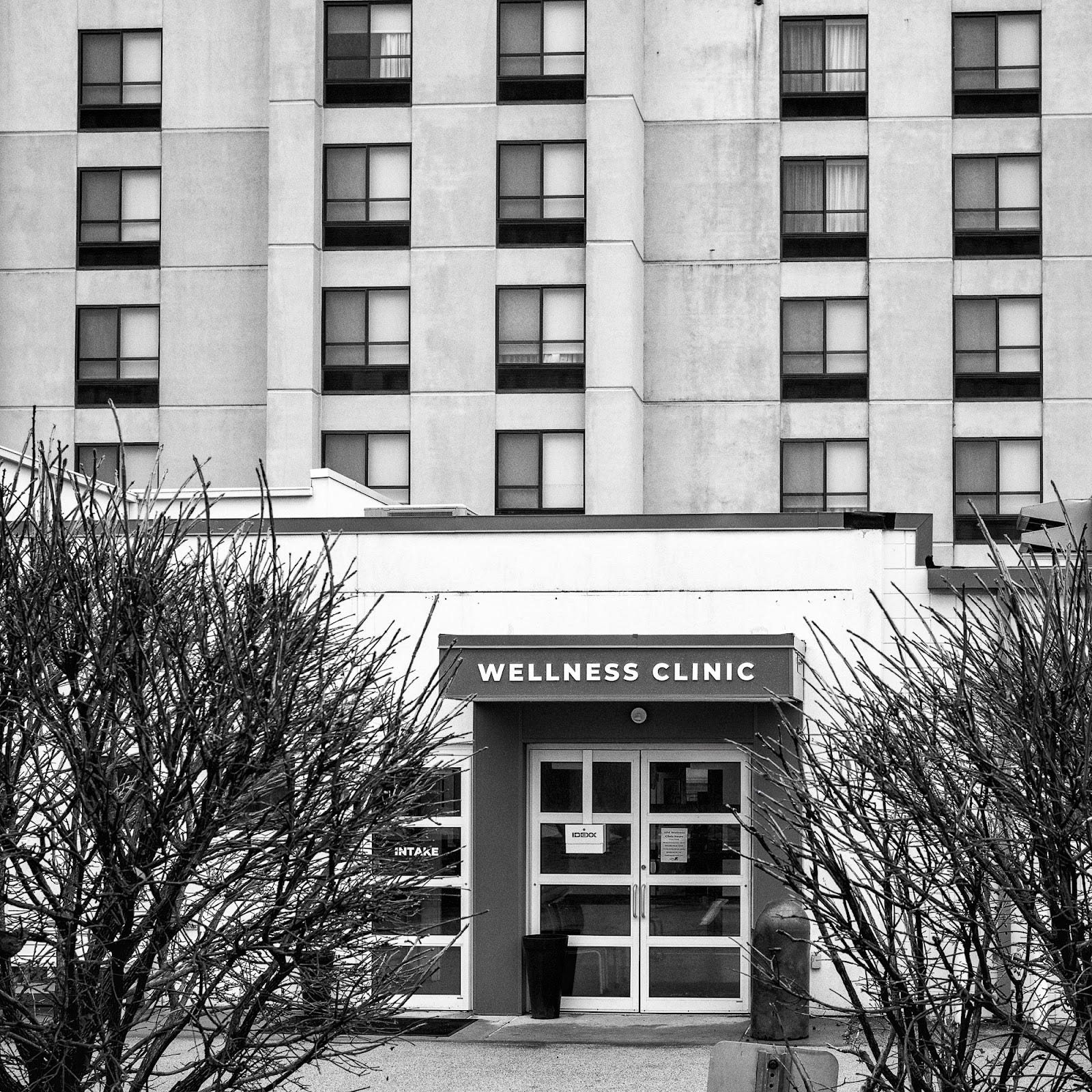
The Wellness Clinic stood out because of its “blank stare” as a building, disconnected from the world around it. But it wouldn’t have stood out to me without the language of New Topographics. The grid-like rhythm of the lines, the flatness of the building’s facade, the clean, minimalist lettering over the door, and nearly monochrome tones, set it apart from what we usually think of as an aesthetically pleasing landscape. Yet it fits the New Topographics sensibility well. The Wellness Clinic appears to be part of a veterinary practice, by the way.
The advantage of knowing another language as a traveler is that we can get along in a different culture and have a deeper, more meaningful experience. The advantage of knowing another photographic language is that it gives us a tool to make meaningful photographs in different contexts. Without the language of the New Topographics, I might have stalked the back streets of Kirkwood and St. Charles, MO, frustrated that there wasn’t anything interesting to photograph.
Dead Darlings*
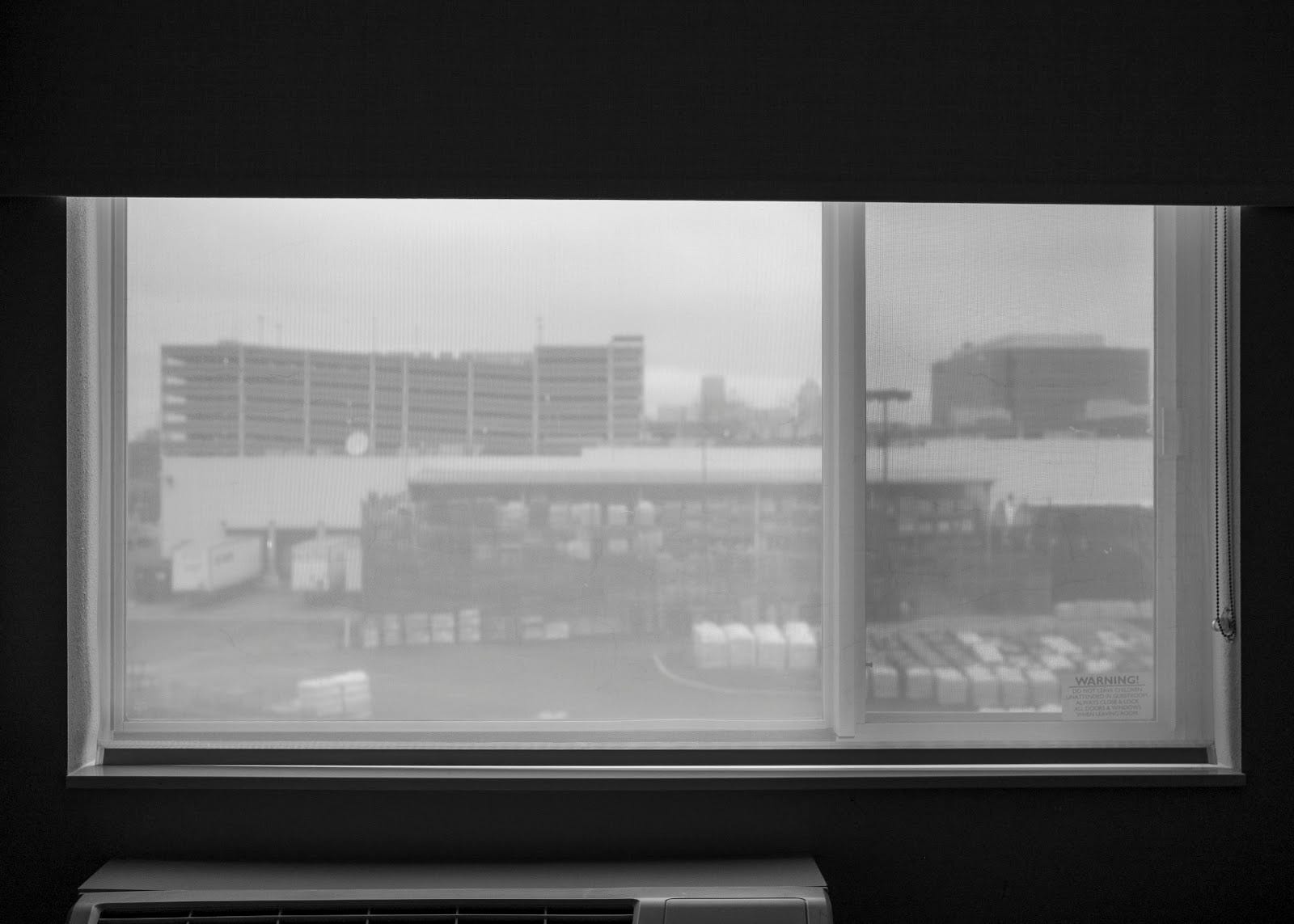
I very much wanted to use this photograph — also from our St. Louis trip — in this post, but I just couldn’t find a place for it. Another darling bites the dust!
I made this photograph because I’m fascinated by these semi-sheer window blinds in hotels. Shielding the room from strong sunlight while allowing some view outside is likely their function, but they also hint at the vagaries of seeing and being seen. Seeing and being seen are particularly germane, I think, in a space like a hotel room, which is both intimate and semi-public (large windows and the constant stream of occupants). I saw this tableau in our hotel on the trip, and reached for my camera. Am I seeing in this moment, or being seen?
*In “Dead Darlings” I share examples of things I wanted to include in the post but that just didn’t fit. They might be text that veered off topic but that I still liked, or, as in this case, a photograph that wasn’t quite right but still has some value.

p.s. It is so useful to hear the context and thinking behind the pictures - as well as what you see and why it is significant. Some artists leave things so open for any interpretation. That doesn't work well for me. I gain much more when I hear those explanations and see things I wouldn't have seen. So thanks for sharing those insights
Such a meaningful entry into the compilations you are creating.
I loved the writing - I could feel myself in the Midwest at dusk experiencing the wintery conditions. I liked all 3 photographs; the 2nd was my favorite.
There are so many voices competing for everyone's attention these days. I rarely pay listen to any of them. But yours is one I find meaningful that's worth time and careful attention.